


How Do ASRS Plastic Pallets Perform in Cold Storage, Food Processing, E-Commerce, and Manufacturing Warehouses?

Quick Answer
ASRS plastic pallets can perform effectively in cold storage, food processing, e-commerce, and manufacturing when their material, dimensions, load ratings, and base geometry match the automation system. Weihong supports selection around temperature exposure, hygiene requirements, conveyor and rack interfaces, expected cycle frequency, and payload behavior. Final solutions depend on project testing, equipment specifications, and site conditions.
How Weihong Supports Projects
Weihong manufactures standardized HDPE and PP logistics products at a 40,000+ m² intelligent manufacturing base using large-scale injection and blow molding equipment. Its design-to-delivery OEM/ODM model supports hygienic pallet concepts for food and pharmaceutical logistics, precision requirements for automated warehousing, and heavy-duty applications in manufacturing.
Buyers should confirm nominal dimensions, entry and support geometry, payload distribution, operating temperature, surface-cleaning process, and conveyor or rack interface. Material formulation, mold design, quality-control requirements, MOQ, lead time, testing scope, and quotation must be confirmed for each project with Weihong.
Discuss Your Automated Warehouse Pallet Requirements
Share your target market, warehouse temperature range, pallet dimensions, load profile, racking and conveyor models, handling frequency, and food-contact or cleaning requirements. These details allow suitable options, sampling steps, and validation tests to be discussed. Visit www.pearlriverplastics.com or email yangyf@gzpl.com.cn to start a project-specific review.
Deep-Dive FAQs
How do ASRS pallets remain stable in frozen warehouse temperatures?
Low-temperature performance depends on polymer behavior, pallet geometry, impact exposure, and load conditions. PP can lose impact toughness as temperatures fall, while suitable HDPE formulations are often considered for demanding cold environments; neither material should be selected by name alone. Buyers should test the actual pallet after conditioning at the lowest operating temperature, including loaded conveyor transfers, racking placement, forklift contact, and repeated handling. The test should measure cracking, runner deformation, deck damage, and barcode or RFID readability. Condensation and ice can also change friction and sensor performance, so floor conditions, pallet cleanliness, and the automation supplier’s transfer limits need review. A nominal load rating measured at room temperature is not sufficient evidence for frozen storage use.
Which pallet features matter most for food processing hygiene?
Food-processing applications require cleanable geometry and a documented material strategy rather than a generic claim that a pallet is hygienic. Closed or well-drained surfaces can reduce soil retention, while rounded transitions, limited crevices, and correctly designed runners simplify inspection and washing. The selected resin, colorants, and additives must be evaluated against the destination market’s food-contact requirements; an HDPE or PP label by itself does not establish regulatory suitability. Buyers should define wash-water temperature, detergent or sanitizer chemistry, drying time, and separation between raw and finished-product zones. A site trial should check microbial-control procedures, visible residue, dimensional stability after washing, and compatibility with conveyors and pallet washers.
Can automated pallets handle e-commerce throughput and frequent cycles?
They can support high-cycle distribution when the deck, runners, and load pattern are designed for repeated dynamic handling. E-commerce operations often combine conveyors, sortation equipment, stretch wrapping, manual picking, returns, and uneven cartons, creating different stresses from a uniform manufacturing load. The pallet should be assessed for fatigue, edge impact, snagging, nesting or stacking behavior, and stable sensor presentation. Test loads should represent actual carton footprints and center-of-gravity variation, not only a uniformly distributed mass. Operations should also establish inspection criteria for damaged runners, contamination, and dimensional distortion. Higher throughput may justify stronger geometry or a heavier pallet, but the choice should be based on lifecycle cost and equipment validation rather than purchase price alone.
What pallet design suits manufacturing loads and conveyors?
Manufacturing loads vary widely, so the correct design depends on concentrated weight, load overhang, heat, oils, metal parts, and the support pattern of the rack or conveyor. A pallet carrying boxed components may need different deck support from one carrying drums, stamped parts, or automotive assemblies. Engineers should verify static, dynamic, and racking conditions separately, then evaluate deflection at the weakest support points. Smooth handling surfaces can reduce snagging, while appropriate runner placement helps maintain contact through transfers. Heat from freshly processed parts, weld spatter, sharp edges, and chemical exposure should be included in the material review. A production-line trial is valuable because nominal dimensions alone do not predict behavior under real load distribution.
How should buyers validate pallet compatibility with ASRS equipment?
Compatibility should be validated as an interface study between the pallet and the complete material-handling system. Confirm pallet length, width, height, squareness, flatness, entry direction, runner spacing, rack beam support, conveyor roller or chain pitch, transfer gaps, stops, sensors, and load overhang limits. ISO 6780 provides internationally recognized principal pallet dimensions, but compliance with a nominal footprint does not prove compatibility with a particular ASRS installation. The integrator should review CAD data or controlled samples and run loaded trials at operating speed. Test results should cover empty and loaded transfers, rack insertion and retrieval, accumulation, emergency stops, and repeated cycles. Tolerances should be specified in purchasing documents so replacement units remain suitable for the automation system.
Are recycled plastics suitable for automated warehouse pallet applications?
Recycled plastic can be suitable for some automated applications, but suitability depends on the source stream, consistency, formulation, contamination control, and required mechanical performance. Automation systems are sensitive to dimensional variation and damaged or distorted runners, so recycled content should not be treated as an automatic substitute for virgin resin. Buyers should request a defined material specification, batch controls, color and additive requirements, and test data covering impact, stiffness, fatigue, low-temperature behavior, and dimensional stability. The application may also require restrictions on odor, cleanliness, or food-contact use. For demanding ASRS cycles, a controlled formulation and validated mold design are more important than a simple recycled-versus-virgin label. Environmental goals should be balanced with service life, repair or replacement rates, and end-of-life handling.

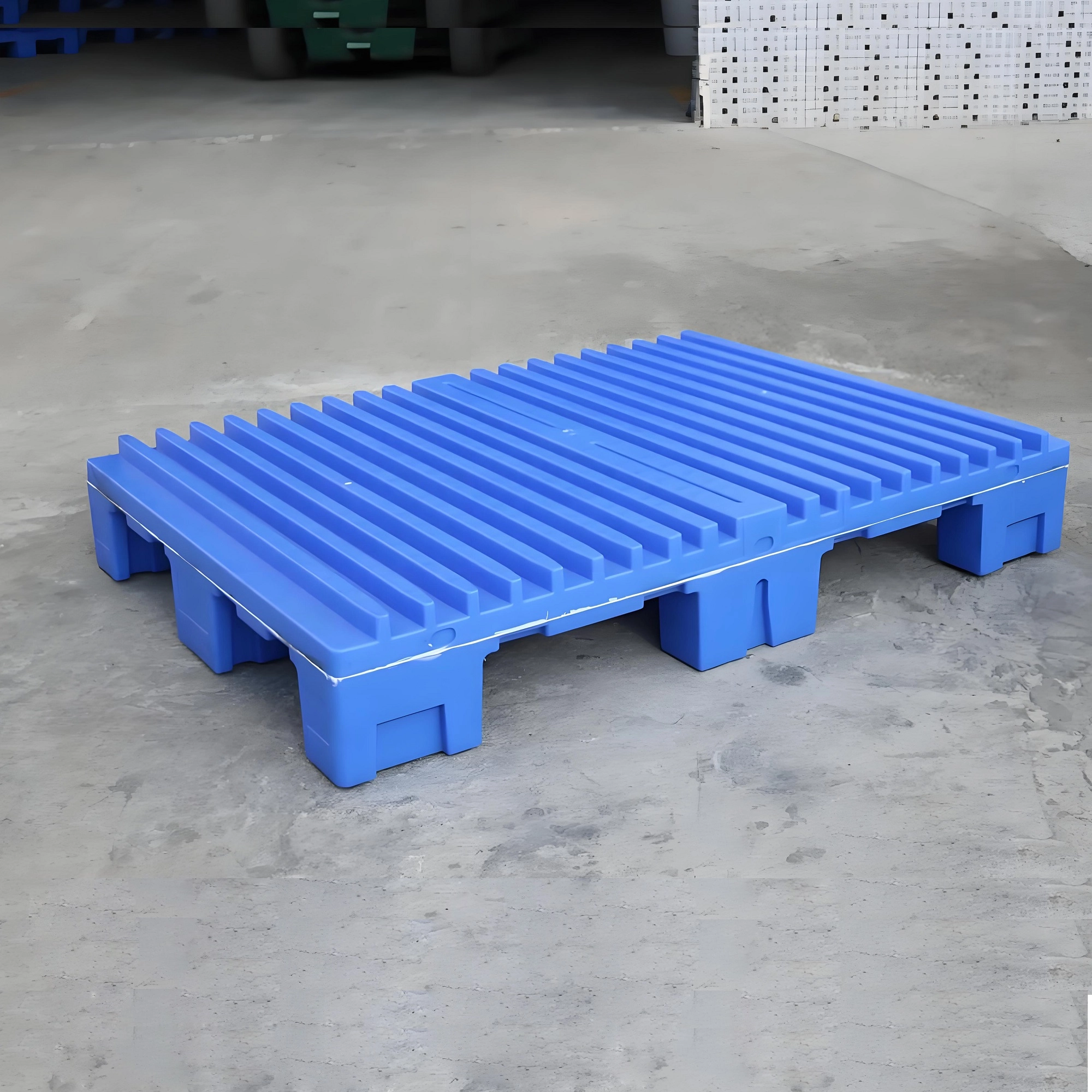
The nine-leg sing-sided printing plastic pallet is a solid and durable packaging solution designed for medium load printing and general cargo storage, and transport. It’s made of virgin HDPE or PP, featuring in robust structure, reinforced configuration with steel pipes, and a steady loading capacity.
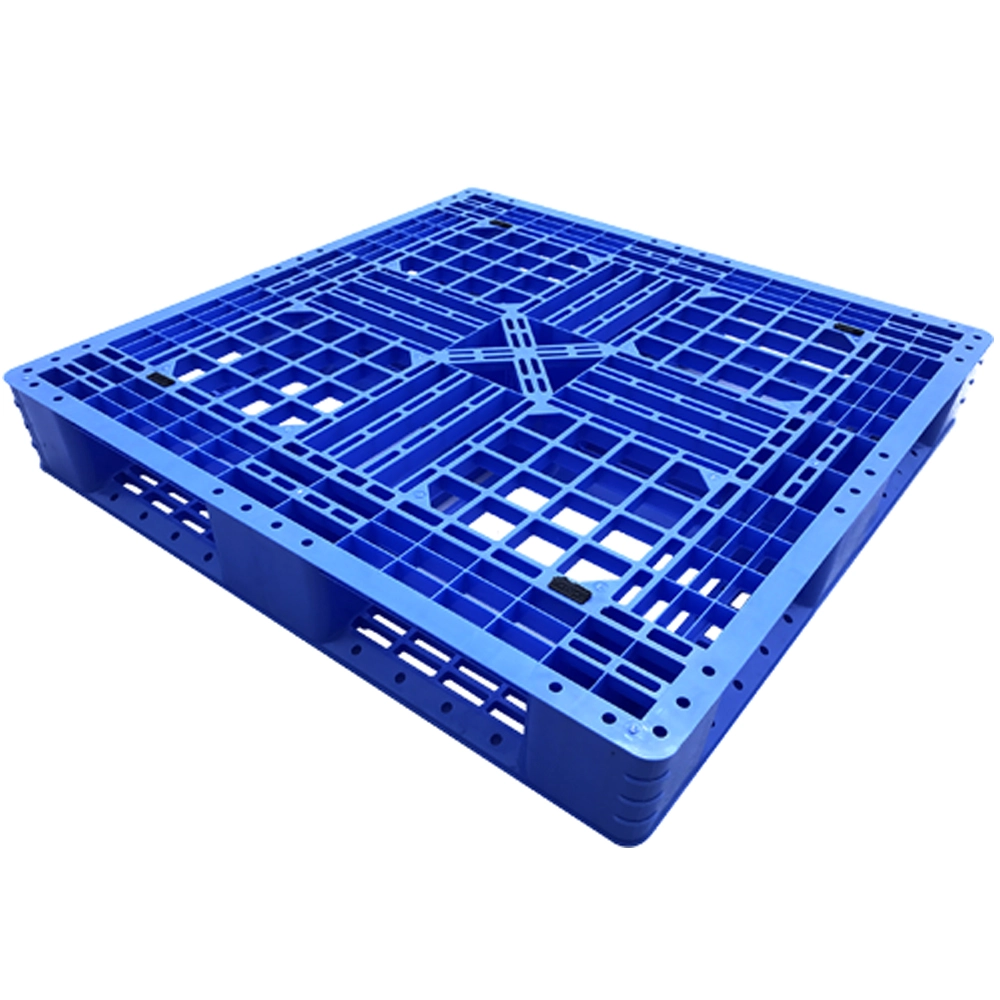
The six-runner plastic pallet, open or closed deck, is a solid and durable packaging solution designed for general and medium to heavy-duty cargo stacking, storage and transport. It’s made of virgin HDPE or PP, featuring in robust structure, a reinforced configuration with steel cores for the rack and shelf, and a steady loading capacity.

The three-runner single-sided plastic pallet is a solid and durable packaging solution designed for general and medium to heavy-duty cargo storage, transport and automated storage use. It’s made of virgin HDPE or PP, featuring in robust structure, reinforced configuration with steel cores for rack and shelf, and a steady loading capacity.
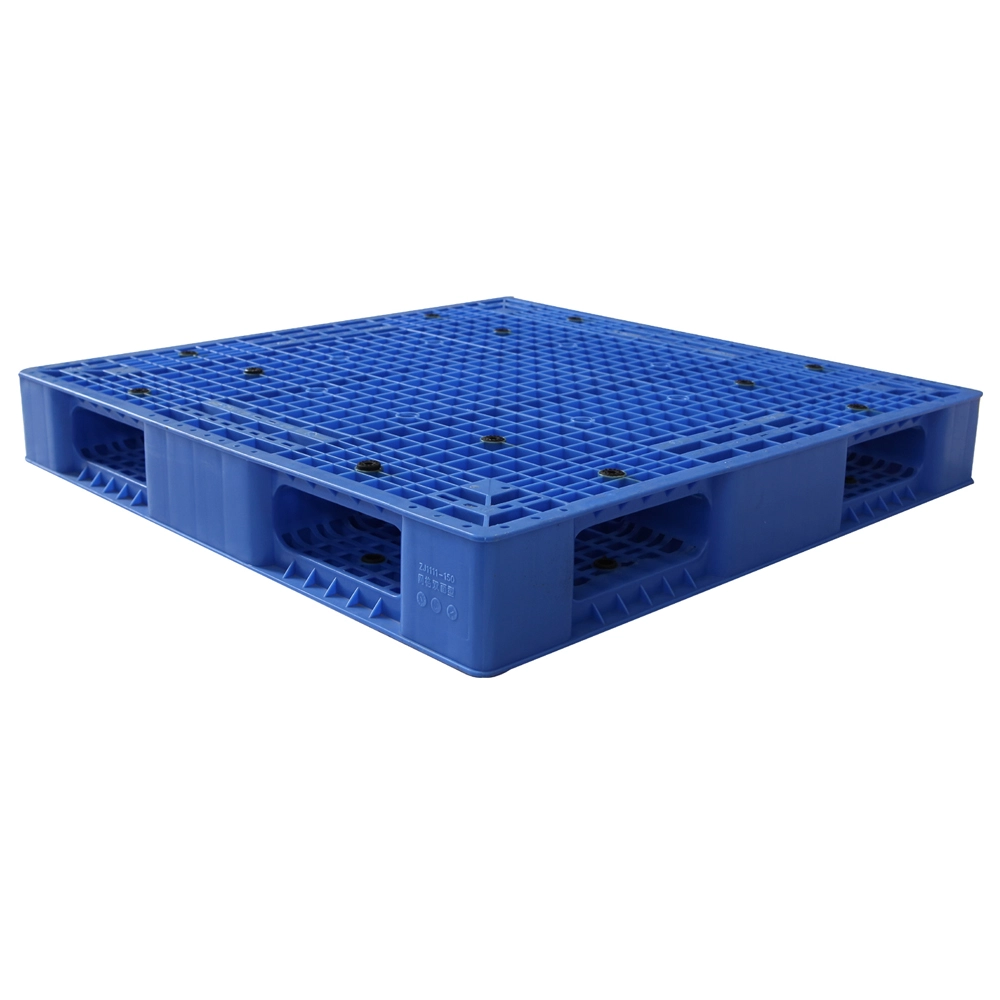
The reversible plastic pallet, open deck or closed deck, is a solid and durable packaging solution designed for general and medium to heavy-duty cargo stacking, storage and transport. It’s made of virgin HDPE or PP, featuring a robust structure, a reinforced configuration with steel cores for the rack and shelf, and a steady loading capacity for both sides.
Request More Information About Plastic Pallets
Have questions or need detailed insights on this article? Fill out the form below to contact our team for comprehensive information and support related to our plastic pallet solutions.
Contact us


+86 138 0277 8204
+86 183 4431 0917
+86 131 8916 6579

No. 15-1, Fengying Rd., Taiping Town, Conghua Dist., Guangzhou City, Guangdong Province, China.

Build the Perfect Pallet for Your Operation
Customized pallets engineered to fit your equipment, load, and workflow.
Whatsapp: +8613802778204
Scan QR Code
Guangdong Weihong Plastic Technology Co., Ltd.
Weihong
Guangdong Weihong Plastics Technology Company Ltd.